Decision Acceleration
Why enterprises move slowly, and how to systematically reduce decision latency across the organization.
Enterprise Transformation · AI Strategy
ConsultingByte helps enterprise and private equity leaders diagnose and close the decision latency that limits AI value, modernization ROI, and integration speed — before it becomes the reason a program stalls.
Every transformation initiative eventually collides with the same wall: not a shortage of technology, but a shortage of fast, well-owned decisions. Agentic AI has made that wall impossible to ignore — compressing execution timelines faster than most operating models can absorb.
Enterprises suffer from coordination failure long before they suffer from a capability gap. Decision latency blocks transformation quietly, one handoff at a time. And AI does not resolve workflow fragmentation. It exposes it, at a speed and scale most governance models were never built to match.
ConsultingByte exists to work on that wall directly — before it becomes the reason a modernization program stalls, a PE investment thesis underdelivers, or a post-merger integration takes twice as long as the deal model assumed.
What We Cover
Every engagement traces back to the same question: where is the distance between knowing and acting, and who owns closing it?
Why enterprises move slowly, and how to systematically reduce decision latency across the organization.
Diagnosing the organizational, technology, data, governance, and execution bottlenecks stacked on top of one another.
Practical enterprise adoption models that go beyond demo-stage hype and into measurable operating change.
Business cases, ROI modeling, technical debt quantification, and platform rationalization.
PE, M&A, and investment-focused technology and architecture assessments ahead of and during a deal.
Operating model, platform, and organizational integration strategy in the years after the deal closes.
The Diagnostic Model
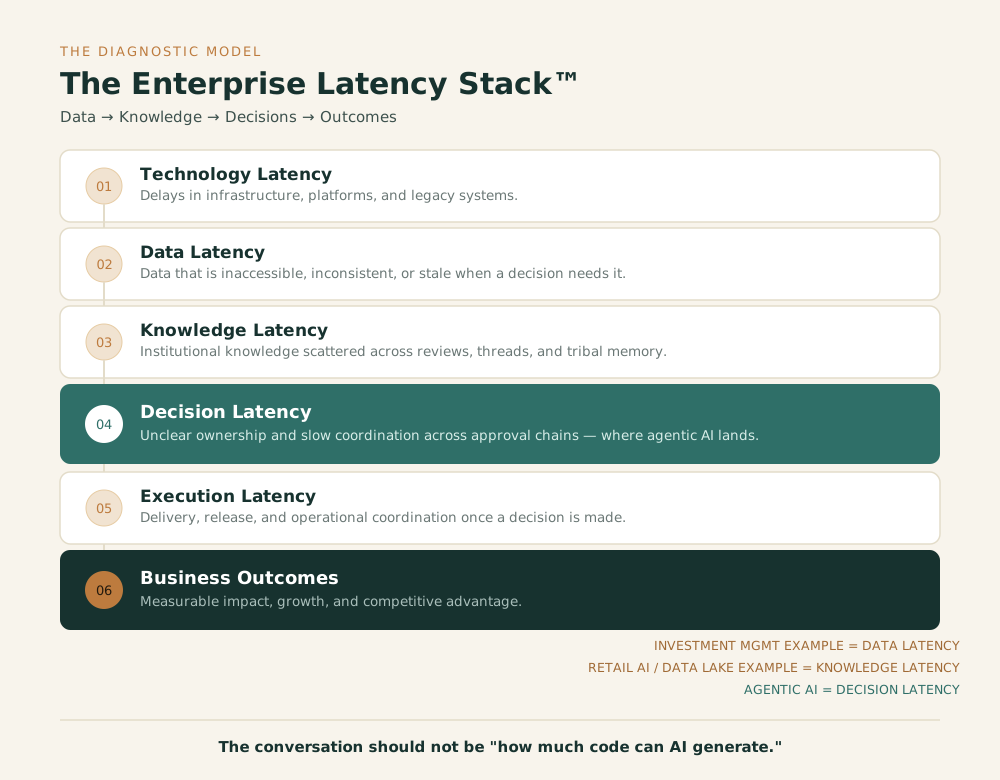
Most enterprise delay is invisible because it is distributed across five layers, each compensating for the one below it. AI accelerates the top of this stack and does nothing for the rest — until an organization redesigns it.
How the IP Develops
The pillars above did not start as products. They started as a pattern we kept seeing, then formalized, then made measurable, then accelerated with software.
Naming the problem in public: coordination failure, decision latency, and the workflow fragmentation that AI exposes rather than fixes.
Turning the pattern into reusable consulting IP: the Enterprise Latency Stack, Decision Friction Index, AI Readiness Maturity Model, and Coordination Complexity Model.
Answering "how do we measure this?" with structured questionnaires, workshops, scoring systems, and maturity heatmaps.
Software-assisted pieces: AI-assisted architecture discovery, dependency mapping, integration risk scoring, and SDLC governance copilots.
Proprietary Frameworks
Each framework exists because we kept seeing the same pattern across unrelated clients and industries.
Maps delay across technology, data, knowledge, decision, and execution layers to show where friction actually accumulates.
Scores how ambiguous decision rights and slow coordination mechanisms are actively costing an organization speed.
Places an organization on the path from isolated tool adoption to full operating model transformation.
Quantifies how many organizational boundaries a typical decision must cross before it becomes action.
From the Point of View Series
Long-form perspective from the field, on the assumption that a well-argued point of view is worth more than another framework diagram.
Point of View
Software delivery is rarely constrained by coding capacity anymore. It's constrained by decision latency — the delays that pile up in architecture reviews, dependency approvals, and cross-functional coordination long before code is ever the bottleneck.
Read the full piece →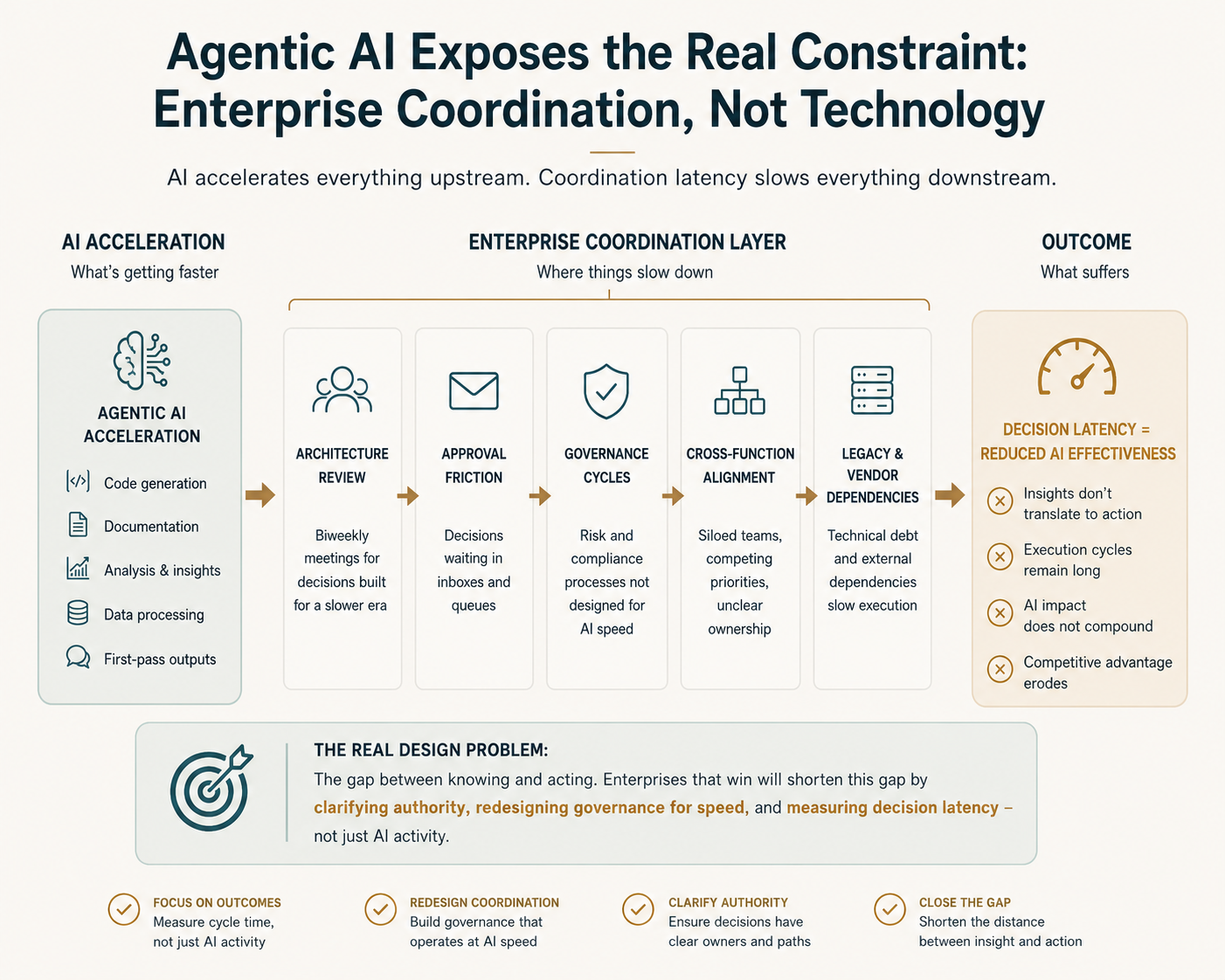
Point of View
Agentic AI will expose enterprise coordination failure long before it meaningfully improves enterprise productivity — not because the technology is deficient, but because most operating models were never built for the speed it enables.
Read the full piece →Get In Touch
Share a few details about the decision, program, or deal you're working through. We reply personally — no automated sales sequence.
If a modernization program has stalled, an AI initiative has plateaued, or an integration is taking longer than the deal model assumed, that is usually a coordination question before it is a technology question.
Start with a conversation